
Tooling for irregular pump-housing contours
The patent concerns the tooling used to manufacture pump housings. Its background identifies large machining allowances, extensive surface finishing and difficult curved or irregular features. ShuiYiYuan's design uses internal pressure and axial feeding to form the material against a dedicated cavity.
The upper assembly contains the die seat, a protective ring, sleeve and T-shaped guide. The lower assembly includes a sealing seat, die inserts and a movable pad. The tool also incorporates a liquid inlet and release hardware, addressing the forming, fluid-supply and removal requirements of the housing.
Lower drive-power demand for the manufacturing equipment is a development objective reflected in the Chinese patent title. A recess at the top of the upper die seat connects to the equipment, and a protective ring surrounds the sleeve. These mounting and protective parts accompany the internal forming structure.
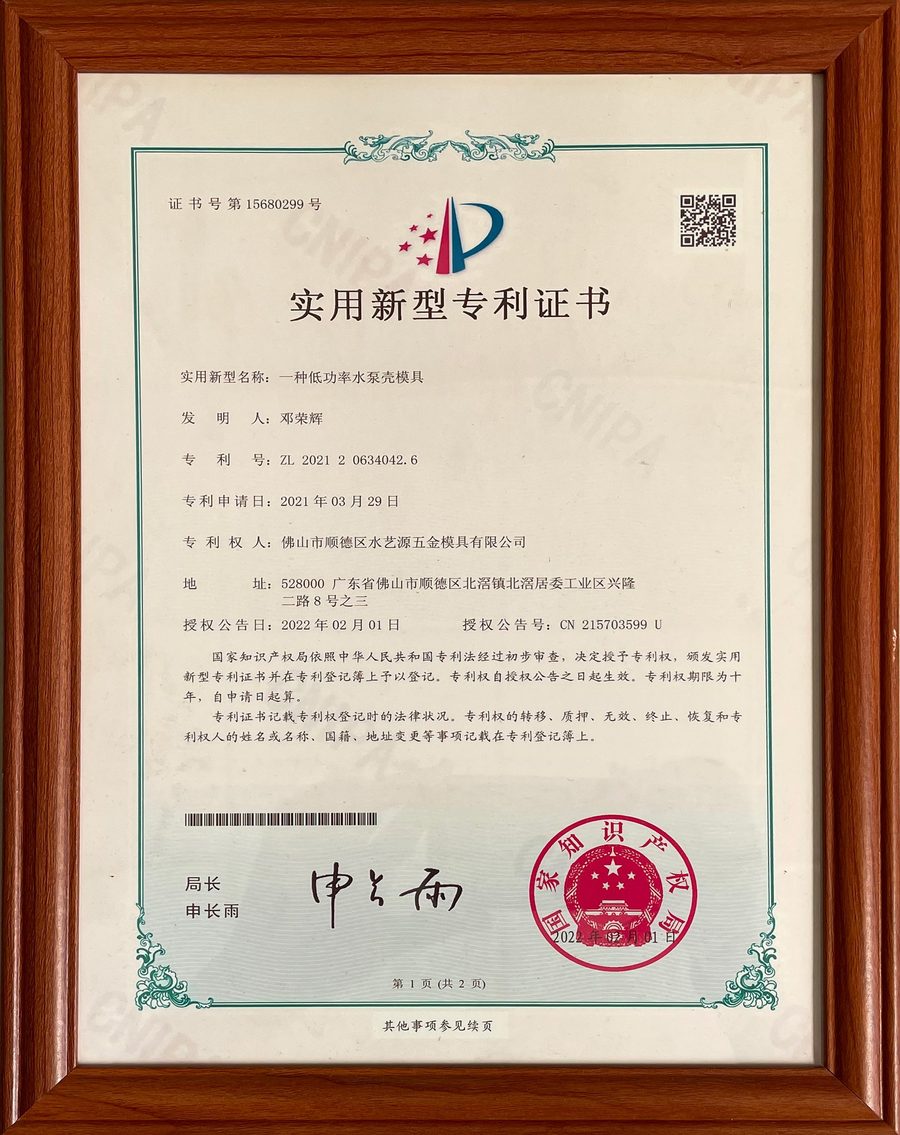
Patent record
| Field | Details |
|---|---|
| Title in Chinese | 一种低功率水泵壳模具 |
| Patent type | Chinese utility model |
| Patent number | ZL 2021 2 0634042.6 |
| Grant publication number | CN215703599U |
| Filed | 2021-03-29 |
| Grant published | 2022-02-01 |
| Inventor | Deng Ronghui (邓荣辉) |
| Patentee named on the certificate | Foshan Shunde ShuiYiYuan Hardware Mould Co., Ltd. |
The grant publication number can also be searched in CNIPA's patent search system.
A forming cavity with fluid inlet and movable release pad
The sleeve contains the T-shaped guide and forming cavity. Two groups of inserts sit alongside the movable pad on the lower die seat. Internal pressurization and axial feeding bring the material into contact with the cavity contour.
A sealing rod at the centre of the lower seat contains the liquid inlet. A locating block at its base holds the connection in position. This brings the fluid passage and sealing hardware together beside the forming cavity.
Release hardware includes a spring and ejector rod in the upper assembly, plus the movable pad, spring and spacer sleeve below. A shoulder screw passes through the pad and works with the spring to permit vertical movement while limiting opening travel. These components assist separation of the formed housing from the die.
Design features
A liquid passage through the sealing rod
The inlet runs through the sealing rod, with a locating block holding its position. Fluid supply and location share the same component group, connected to the sealing structure at the centre of the lower die seat.
Spring-assisted release with travel restraint
The movable pad, spring, spacer sleeve and shoulder screw provide a vertically moving release assembly. A separate spring-loaded rod is fitted above. The design includes mechanical support for releasing the housing and constraining pad travel as well as the cavity that forms the part.