
Hydroforming tooling for bathroom flanges
The patent proposes a hydroforming die for closed-bottom bathroom flanges as an alternative to a die-casting tool. The upper die, lower die and lower frame enclose the forming cavity. High-pressure water supplied through internal passages shapes the material inside that cavity.
The upper die attaches to an upper mounting plate. Below it are the frame, base plate, lower die and hydraulic-cylinder components. Cylinder rods connect to the upper plate to open and close the tool, while the lower guide and connected passages supply forming water. Hydraulic actuation and forming-water supply are separate systems within the assembly.
The patented details include a removable lower die, a matching frame recess, radiused contact edges and piston-rod seals. These features address tool replacement, die engagement and sealing around the drive components alongside the cavity itself.
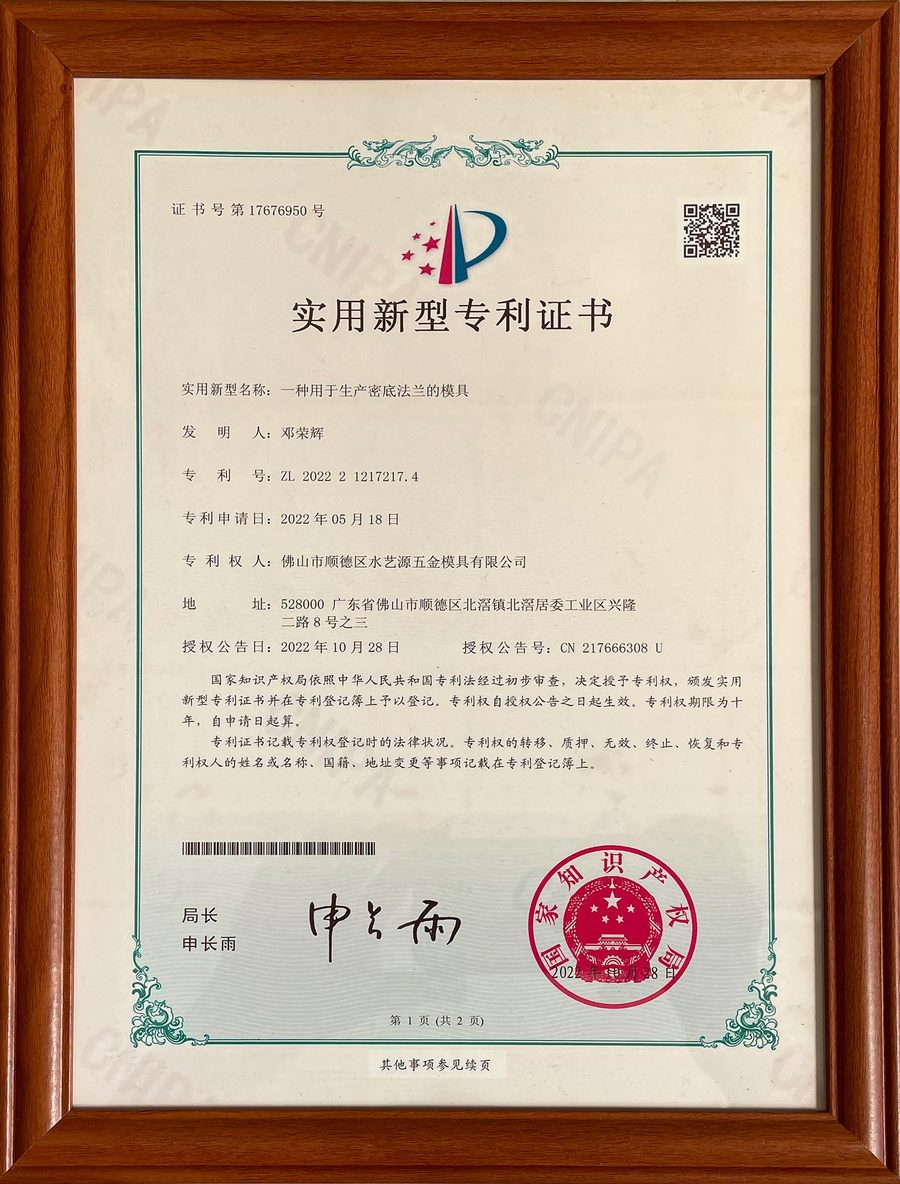
Patent record
| Field | Details |
|---|---|
| Title in Chinese | 一种用于生产密底法兰的模具 |
| Patent type | Chinese utility model |
| Patent number | ZL 2022 2 1217217.4 |
| Grant publication number | CN217666308U |
| Filed | 2022-05-18 |
| Grant published | 2022-10-28 |
| Inventor | Deng Ronghui (邓荣辉) |
| Patentee named on the certificate | Foshan Shunde ShuiYiYuan Hardware Mould Co., Ltd. |
Read the Chinese patent text on Google Patents
The grant publication number can also be searched in CNIPA's patent search system.
An enclosed cavity with separate water and oil passages
The lower die fits into a matching recess in the frame and is held by threaded connections. Radiused edges at the die interface assist entry of the upper die and movement of the material as the tool closes. The frame and die pair together define the forming space.
A passage through the lower guide connects to internal water channels. The cylinders that move the upper die have separate oil passages, with seals where their rods meet the frame. Glands and annular grooves provide sealing features and space for oil flow. Forming water and hydraulic oil therefore serve distinct functions.
Both the lower die and lower base plate can be detached from the frame. The patent also describes piston rods with different annular-groove heights to alter the lift height in conjunction with the selected lower die. Replaceable forming parts and configurable opening travel are further features of the design.
Design features
A recessed die seat and radiused interfaces
The lower die fits a recess in the frame and is secured by threaded connections. Radiused edges at the upper and lower die interface assist engagement and material movement. These details address the mounting and contact surfaces surrounding the forming cavity.
Replaceable lower tooling with lift-height configuration
The lower die and base plate have detachable connections. Piston-rod geometry also provides a means of configuring lift height. Corresponding component changes accommodate tooling for parts of different heights within the combined forming and opening assembly.