
Why weight or final shape is not enough to quote a part
If you already have a 2D drawing, 3D model, or existing sample, you probably want two answers first: can this part be made by tube hydroforming, and what will the tooling, prototypes, and production parts cost?
There is no dependable price-per-kilogram rule for a custom hydroformed part. Two components with similar material and weight may need very different tool structures, tube preparation, tryout work, and inspection.
Your program may also be at a different stage. You may have an early design and need a feasibility direction, an existing component that needs a new hydroforming contract manufacturer, or approved prototypes that are ready for production-intent tooling. The same CAD model can appear in all three situations, but the required work is different.
A visually simple tube can be difficult if an expansion is too close to the end, there is not enough sealing length, or the formed part cannot be removed from the die. A part with several smooth curves may be more manageable when section changes are gradual, the tube condition is controlled, and critical dimensions are clearly identified.
Define the part, tool objective, sample-acceptance criteria, and required condition at delivery first. The quotation can then describe the work you are actually buying.
Cost areas in a tube hydroforming project
A tube hydroforming project normally includes tooling development, prototype production, and batch processing. Each covers different work and is priced on a different basis.
Drawing review and die manufacture
Process planning, die design and manufacture, and the first tool tryout.
Tryout and sample approval
Agreed sample quantity and review of dimensions, interfaces, or function.
Part processing and delivery
Incoming tube condition, processing scope, inspection, packing, and lot size.
Tooling development includes drawing review, process planning, die design and manufacture, and the first tool tryout. Most of this work takes place when the project starts. A tool used to confirm that a part can be formed may differ from one intended for long-term production in construction, durability requirements, and maintenance provisions.
Prototype production begins with tool tryout and adjustment. The agreed review may cover only the part shape and critical dimensions, or it may also include assembly interfaces and functional validation. Sample quantity, inspection items, required records, and design revisions determine the work at this stage.
Batch processing is priced according to incoming tube condition, hydroforming scope, agreed supporting operations, inspection and packaging requirements, and quantity per lot. Programs with the same annual demand can require different amounts of setup, first-piece inspection, and packaging when their lot sizes differ.

1. Part geometry defines the process route
Tube hydroforming is not a matter of placing a straight tube in a die and applying pressure. Local perimeter growth, round-to-nonround transitions, the spacing of multiple expansions, combined bending and expansion, the parting line, and end-sealing conditions all influence how material reaches the target shape.
When we receive your CAD, we review practical questions such as:
- Can the blank enter the die and can the formed part be removed?
- Is enough material available for the expanded regions, and where are splitting or wrinkling risks likely?
- Does the incoming tube need a defined prepared condition before hydroforming?
- Is there usable length for sealing and load transfer at the ends?
- At what stage should holes, ends, and trim profiles be produced?
- Which dimensions are controlled by the forming die, and which depend on trimming or later assembly?
Providing both a 2D drawing and 3D model is helpful. The model communicates continuous shape; the drawing communicates datums, tolerances, material, and critical requirements. A model without critical dimensions can show the part while leaving sample acceptance undefined.
2. The tube condition matters beyond the material name
“Stainless steel,” “aluminum alloy,” or “high-strength steel” identifies a material family, not the complete hydroforming input. The review also needs the specific grade and condition, outside diameter, wall thickness, dimensional variation, welded or seamless construction, and any longitudinal-seam requirement.
Outside diameter and wall affect material consumption, sealing, the forming window, and equipment load. For welded tube, the manufacturing seam remains present. If it crosses a highly strained region, its position and consistency may need to be considered during tryout and validation.
Material ownership should also be stated. With customer-supplied tube, the route is developed around an agreed incoming condition. If sourcing is included, purchasing specifications, permitted substitutions, minimum order quantities, and price validity need to be confirmed.
3. Is the tool for prototyping or repeat production?
When the objective is to prove that a concept can be formed, the tooling strategy may prioritize controlled initial investment and flexibility for change. When the design is released for recurring production, stability, wear items, maintenance, and repeat setup become more important.
An executable tooling scope normally identifies:
- prototype, upgradeable, or production-intent objective;
- die design, manufacture, assembly, tryout, and agreed revisions;
- sealing, location, inserts, and wear-item provisions;
- separate trim fixtures, checking fixtures, or other required tooling;
- tool ownership, storage, maintenance, and engineering-change rules.
If you already own a tool and only require hydroforming contract processing, send the available tool information, equipment interface, and current part condition. Compatibility with the press, blank, and acceptance requirement still needs to be confirmed before production pricing.
4. What must the prototype prove?
One of the most common prototype-stage misunderstandings is a different definition of “sample complete.” Visual completeness, critical dimensions, wall-thickness requirements, assembly fit, and customer functional testing represent different acceptance scopes.
You may not need to validate everything in the first round, but the characteristics that decide whether the program can continue should be identified. An interface position, sealing region, or assembly datum is often more useful than applying an unnecessarily tight tolerance to every dimension. Clear critical characteristics give tryout and measurement a practical target.
If the program needs a dedicated gauge, third-party test, destructive examination, or another special validation method, include that requirement in the RFQ. It can then be reviewed and priced as a defined item instead of being hidden in an unexplained total.
5. Volume and release pattern affect unit price
Prototype, launch, and stable-production lots have different cost structures. Prototype quantities are small, but engineering, tool setup, first-piece confirmation, and process adjustment represent a high share of the work. Stable production spreads these activities over more parts, while lot size and delivery frequency still matter.
A useful volume forecast states the initial sample quantity, launch quantity, expected annual demand, intended release size, design-freeze target, prototype date, and production start. Even a staged estimate is more useful than saying only that “volume will increase later.”
What should the first review deliver at each project stage?
You do not need to wait for a fully released drawing before requesting a review. The important point is to identify the current project stage and expect an output that matches it.
| Current stage | Most useful starting inputs | What the first review should deliver |
|---|---|---|
| Concept and feasibility | 3D shape, target material, major interfaces, adjustable regions, and an approximate volume level | Key feasibility questions, missing data, design concerns, and whether to proceed toward a prototype or continue adjustment |
| Prototype development | Controlled drawing, tube condition, critical dimensions, sample purpose, quantity, and target date | Tool objective, tryout scope, prototype quantity, acceptance focus, and a staged quote |
| Production launch or resourcing | Released drawing, existing sample or tool information, incoming condition, annual volume, and lot size | Equipment and tool compatibility, required condition at delivery, release conditions, and the basis for repeat-production pricing |
An early concept should not be treated as if every condition is frozen. A production resourcing project should not restart with a general process explanation when existing parts and tooling data are available. Clear stage information keeps the first review focused on the questions that actually block the next decision.
How to control cost without weakening the part requirement
First, separate functional characteristics from general dimensions. Features that control assembly, sealing, load transfer, or downstream location deserve focused control. Other dimensions should use requirements that reflect the forming, trimming, and measurement route. Tightening every value can add tryout and inspection without improving the component.
Second, identify which regions are frozen before the tool starts and which remain open to adjustment. If the design is still developing, marking open regions allows the prototype strategy to retain necessary flexibility. A section, end, or interface change after die manufacture can reopen forming, trimming, and validation work together.
Third, review the tube blank, forming, end and trim work, inspection, and delivery quantity as one route. The lowest local price for one step can move cost into later fixtures, rework, or repeated validation. A complete route shows which activities can be combined and which need separate control.
Finally, provide a realistic release pattern. A high annual volume divided into frequent small lots cannot use the same assumptions as a planned large release. If the schedule is still uncertain, provide low, medium, and high staged ranges and allow the recurring quote to be updated when actual lot conditions are known.

What happens after you send ShuiYiYuan your drawing
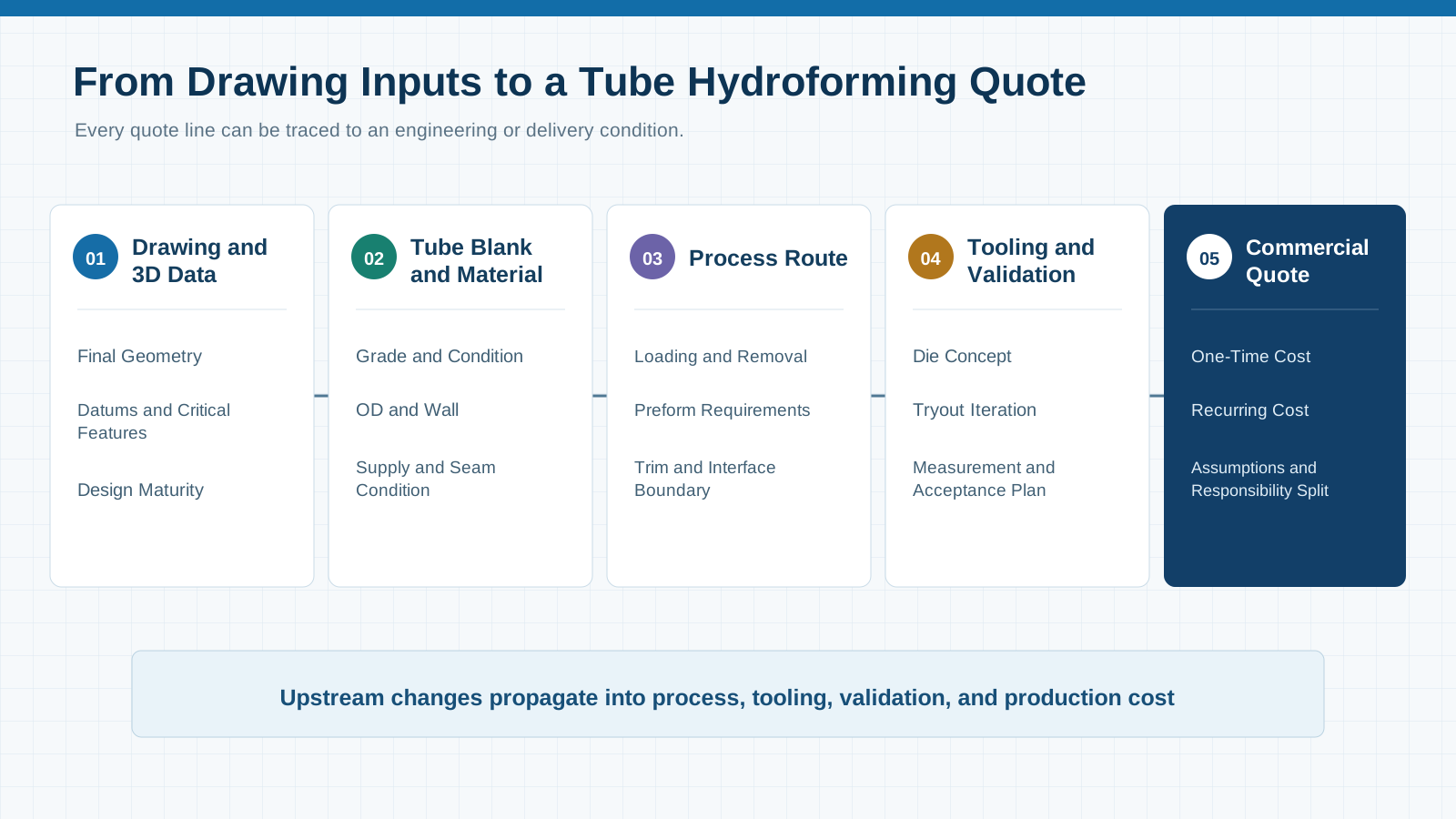
We do not apply a generic rate card to a custom part. A new project normally moves through five steps:
- Check the available information. We confirm whether the drawing, model, material and tube data, critical requirements, volume, and required condition at delivery are sufficient to begin.
- Review the forming process. We identify the key loading, sealing, material-flow, removal, end, and trim questions, then list the information that still needs your confirmation.
- Define the immediate project stage. We determine whether the next need is further feasibility work, prototype samples, a production-intent die, or contract hydroforming with existing tooling.
- State who is responsible for each operation. We identify ShuiYiYuan’s work, customer-supplied inputs or downstream verification, and any supporting operation that still requires confirmation.
- Quote by stage. One-time tooling and engineering, prototype and tryout work, and repeat production are described separately so that each price has a clear outcome.
An illustrative path from RFQ to a quote
The following scenario explains the review method only. It is not a customer case and contains no invented price or performance data.
Suppose you are developing a stainless-steel nonround tube with two section changes, one located near an end. The 3D model is ready, but the 2D drawing shows only overall dimensions. You plan to purchase a small prototype lot before deciding on production.
In this situation, we would not price the final shape alone. The first discussion would normally confirm whether sealing length can remain at the end, which section controls assembly, whether the formed ends require trimming, who supplies the tube, and whether prototype approval is based on dimensional inspection or a customer fit test.
Once those points are clear, the program can be separated into a logical sequence: feasibility and tool concept, tryout and sample confirmation, then stable-production conditions after design release. The quote tells you what the tool must accomplish, what the sample stage delivers, and which volume and incoming condition support the production price.
If the review identifies a local feature that severely restricts material flow, we can explain the cause and possible adjustment direction. The customer retains the design decision. The purpose is to remove avoidable iteration before the die is manufactured, when changes are easier to evaluate.
What to send with your RFQ
| Input | Recommended detail | Why it is needed |
|---|---|---|
| 2D drawing and 3D model | Controlled model plus drawing with datums, tolerances, and notes | Defines shape, tool boundary, and acceptance together |
| Material and tube blank | Grade, condition, OD, wall, welded/seamless state, seam requirement, and supply owner | Supports material-flow, sealing, and purchasing review |
| Critical characteristics | Assembly interfaces, sealing zones, key sections, and functional tolerances | Gives tryout and measurement a clear target |
| Design status | Concept, adjustable, near release, or frozen | Guides the tooling and change strategy |
| Volume and schedule | Prototype, launch, annual and lot quantities, plus target dates | Separates prototype, launch, and production cost |
| Delivery scope | Incoming condition, expected delivered state, supporting operations, and validation | Aligns the quote with what you intend to buy |
Incomplete information should not prevent you from contacting us. Mark unknown items as open. We can first identify which gaps block feasibility and which details can be completed later.

What ShuiYiYuan can take on for a hydroforming project
Depending on the project, ShuiYiYuan can quote die development, contract hydroforming, equipment and tooling customization, trial parts, sample confirmation, and repeat production. Confirmed deep-drawing and laser-cutting capabilities can also be reviewed when the part requires them.
If your delivered component requires additional upstream or downstream operations, testing, or assembly, list them in the RFQ. Before quotation, we will identify what can be included, what requires further confirmation, and what should remain customer- or partner-supplied. This keeps the delivery boundary clear before the program begins.
What a useful quote should give you
A practical quote lets you answer four questions: What is included in the one-time tooling and engineering work? How many prototypes will be delivered and what must they prove? What material, quantity, and incoming condition support the production price? What happens if the design or scope changes?
If you already have a drawing, model, or existing sample, send the information you have. Even when some parameters remain open, ShuiYiYuan can begin with feasibility and missing-input review and help turn the project into a hydroforming route that can be developed, prototyped, and quoted.